Libraries in Norwich - a history

Wednesday, April 15, 2009

I went to Norwich last week, on a whim. Having read that Norwich has the busiest library in the UK, being a library fan, I decided to go to see it for myself. I also learned that having opened in 1608, Norwich's library is among one of the oldest public libraries in England. So, the day was set for a fascinating day of library encounters.

Before I went, I had a look in the Royal Geographical Society's Foyle Reading Room at some old maps of Norwich - dating from 1946, 1914, 1910, 1830, 1834 & 1766. The later three showed two library sites, so I set off to find out what was there now.

The first Norwich library was established in 1608. Three rooms of a house belonging to Jerrom Goodwym, a swordbearer, were converted into a library for use by visiting preachers in a building adjoining this, St Andrews Hall. The library stood here for 193 years.


Site of old Norwich library - St Andrews Hall

This building housed a private subscription library, which also doubled as Norwich's library for some time, between 1837 and 1976. The building is now a tastefully renovated restaurant.


Sketch of Norwich library


Old Norwich library


Inside old Norwich Library


In early 19th century, Norwich was dubbed the "Athens of England" for its intellectual life and society. So there was call for a second library, and in 1857 another library opened at this building on St Andrew's Street.


Old Norwich library site


The owners, sadly, could not find a suitable notary to open the building (they had asked the Duke of Cambridge, Lord Stanley, Gladstone, Lord John Russell, and even William Ewart, a well-known library campaigner).

Apparently, this was the UK's first building specifically designed as a library. It's now gone, demolished. The site on St Andrews Street stood from March 1857 to December 1962.


Site of old Norwich library - St Andrew's Street


The library then moved to the site it currently occupies - although the building has changed. It burned down in 1994 due to an electrical fault. Here's what it looked like inside, sometime in the 1960s.


Inside Norwich library


And now, the library is a bright, open, airy place, all glass and light. It's laid out more like HMV than a library, and has Council information, CDs, DVDs, books, internet and local archives all on one site. And the books are good - I noticed an architecture book I've previously only seen in gallery shops. And to top it all, it's getting even bigger.


Norwich library @ the Forum


Inside Norwich library

I thoroughly enjoyed my day in Norwich, and its libraries. Here's hoping it continues to have success for another 400 years.

Litter on beaches

Tuesday, April 14, 2009

I was right when I said that Chesil Beach was full of rubbish, with a coastal litter survey for the Marine Conservation Society today finding 385,659 individual pieces of litter on 374 popular beaches. Over a third of that comes from the public.

Lots of worthy comment in this article about needing dedicated litter reduction plans, incentives to recycle and so on, but one thing that may help are a few bins. I don't remember seeing any on Chesil Beach (admittedly, it's probably not so easy to install them there).

True or False Tour #2

Saturday, April 11, 2009

A colleague who hadn't been on our True or False Tour / Pub Crawl in January asked me to do it again. I jumped at the chance - it was such fun putting it together.

So yesterday, I joined my colleague, and Susanna, Tobias & Caitlin from Sweden to see London, drink in some pubs, and tell lies and tell the truth.

I made a few changes this time around. Instead of having a helper, I was more like a traditional tour guide - except some of my stories were true, and some were false.

This gave me flexibility to make bits up as I was going along, and meant I wasn't talking for a very long time!

I'm happy to report it all went swimmingly well. Caitlin remarked at one point that I should do more of these tours, and I certainly am planning too.

So, in the meantime, if anyone wants a tour around London with fun true-or-false quiz game built in, let me know!

Sounds Like Teen Spirit - Junior Eurovision film

Tuesday, April 07, 2009

I went to a screening of Sounds like Teen Spirit tonight, the documentary about Junior Eurovision. And it's about so much more than Eurovision: it's about being a kid, becoming a teenager, learning about life and love and losing.

We meet 4 of the contestants in the 2007 Junior Eurovision - Giorgios from Cyprus, Marina from Bulgaria, Mariam from Georgia and band Trust from Belgium - and follow their preparations to go to Rotterdam and their time at the Contest.

These kids are a world away from what you expect - not precocious stage school brats, they're warm, funny, innocent, disarming, chatty, shy, lovely kids.

10 year old Yiorgios from Cyprus is a chatty, funny guy who gets teased at school, but loves to sing and dance and be in the moment.

Marina, from Bulgaria, lives in a good home, but misses her father who is divorcing her mother. At one point, she wonders whether it's better to have no feelings, as then you never feel pain.

Mariam, from Georgia, is delighted to represent her country and have its flag among Europe's others, even if her family's TV only works long enough to see her perform.

And Trust, from Belgium - three guys and 1 girl - are teenagers learning about love and being endearingly awkward adoloscents.

I loved this film - it was warm, funny, sad and absolutely delightful. Director Jamie J Johnstone does a wonderful job, bringing the kids' personalities out with a warmth and honesty which shines through. He approaches the show without any cynicism which gives the film real heart and affection.

Go see this - it is life-affirming and heart-warming. It will leave you smiling, and thinking, for hours, and whether you like Eurovision or not, you'll come with a sense of joy in performing, music and youth.

Junior Eurovision: the movie

Thursday, April 02, 2009

Someone has made a film about Junior Eurovision - long since forgotten in the UK, but alive and kicking out East - and called it Sounds Like Teen Spirit. Goodness - it all looks rather jaunty. I've been invited to a preview screening next week so I shall report back.


Roisin Murphy draws the world!

Wednesday, April 01, 2009

I went out last night to the launch of Simon Henwood's new book. Simon Henwood - previously unknown to me - is the boyfriend of popdiva Roisin Murphy, and Roisin was DJing at the launch. So I popped along to hear her play some tunes.

In between spying the ridiculous Shoreditch types wearing outré clothing, I dug out my pen and pad and asked Dennis to draw the world and Sandro to draw Italy (always remembering my EuroGlobe & MyWorld projects, that's me).

But then a suggestion flashed my way from Henry & Dennis - go ask Roisin Murphy to draw the world. Could I? Would I? Should I?

It's a no-brainer. Of course I should. I drew my courage, held my breath and off I went. Once she finished swapping numbers with someone else, I tapped her shoulder.

Adrian - Hi, I wonder if you could do me a favour - I have a project where I ask people to draw the world. Would you do it for me?
Roisin - Yeah, sure (like it's the most normal thing in the world)

And so she did. So here's the world, as drawn by Roisin Murphy. It's surprisingly stark - no scaffolding, jaunty hats, no ostentatious glovery. But utterly delightful.


Draw the world, see the world

Monday, March 30, 2009

I asked Itinerant Londoner Geoff to draw the world (for my MyWorld project) just before he left London to see the world.


And while the pen and pad was out, Geoff decided to be the UK-candidate for my EuroRevision Project. So here's Geoff's version of the UK.


UK, drawn by Geoff

Tree @ Natural History Museum

Thursday, March 26, 2009


Tree is the short and succinct name for a new permanent installation at the Natural History Museum.

Erected to commemorate 200 years since Charles Darwin's birth, and installed in the ceiling of a gallery, tree takes its concept from the Darwin's tree of life. It's a wooden, cross-section of a 200 year old oak tree with branches stretching across the gallery's ceiling.

Most impressively, at over 17 metres long, Tree will be the Natural History Museum's largest botany specimen on display.

I was impressed by the way the artist Tania Kovats managed to mix her artistic touch with the Museum's scientific endeavour. I liked how as I looked at the tree, I started to consider the science and its 'natural history'.

Hiberno-English and Irish words

Tuesday, March 24, 2009

As it was St Patrick's Day last week, many of my recent conversations have been about Ireland and Irish-ness, with accent nearly always the most popular subject.

I was reminded of a print out I had with 22 examples of Hiberno-Irish dialect - and while I agree with most of the examples, some are very 'stage leprauchan'.

The examples are:

1. Is it Commerce he's studying in College?
2. Peter asked John was he at the match on Sunday and did he see Sheila there.
3. They spoiled her as a child and she's a very bold girl in school.
4. How long do you know Margaret?
5. It's a right mess he's after making of it.
6. I saw two sugawn chairs and a pine table for sale.
7. My brother learned me how to drive.
8. Did you ever hear her talking about anything only study?
9. I caught a fine salmon but the rod broke on me and it got away.
10. He has no sense for an eighteen year old: I saw him out walking yesterday without a coat and it raining.
11. He's hopeless to study now: he usen't be like that when he was younger.
12. Is it Sunday the match is on?
13. See is it on the shelf.
14. Are you going to town? I am. Is it a message you are wanting?
15. He's dead sound, a real sincere young fellow altogether.
16. We were here ages before he came.
17. How can she study with the state she's in?
18. I was just after putting down the phone when I realised I forgot to tell you about the party.
19. Her face was all swollen with the mumps.
20. I do be falling over that yoke about ten times a day.
21. I'm on the pension nearly three years now.
22. Every morning I do be after missing the bus.

Numbers 1, 5, 9, 12 and 14 use an odd-for-English sentence structure, mainly (I think) as it comes from a direct translation from Irish (Gaelic).

3, 11, 14 and 20 have words for other words which may be specific to Hiberno-English: bold for naughty, the contraction usen't, message for shopping and yoke for thing. These are my favourite, and there are many more, such as:

press for cupboard
'give out' for 'tell off'
'copy book' for 'note book / jotter'

History of my House - Southwark local history library

Sunday, March 15, 2009

I've been digging more into the history of my house. The street does not appear on the 1911 census, so I surmised it either had a different name in 1911 or didn't exist.

Looking at some old maps in the RGS Reading Room brought a little enlightenment - I saw a map from the late 1800s with no street, and one from 1920 with a street. So, it was built sometime at the beginning of the 20th century, making it Edwardian, or (very) late Victorian.

I ordered Godfrey edition maps from 1894 and 1914 which confirmed this (fantastically swift customer service from Alan Godfrey Maps, by the way).

Southwark's local history library - temporarily relocated to Peckham due to renovation - had an index of streets which indicated that street was given its name in 1911. So, the street is 98 years old.

Much more excitingly, in the local history library, I found out the names of all voters who lived in the house from electoral registers.

The earliest I can trace on the street is 1913, but for the first few years my house number is not used (maybe the house was empty? Or maybe the occupants didn't have the right to vote).

And then, from 1918 onwards, these people lived in my house:

  • 1918 - 1929 - Daniel & Clara Ayling
  • 1929-1931 Frederick Jordan, Alice Jordan & Frederick Thomas Jordan
  • 1931-1938 Alice Jordan & Frederick Thomas Jordan
  • 1938-1939 Alice Jordan
  • 1939-1940 Thomas Williams & Ellen Alice Williams
  • 1940-1945 - ?
  • 1945 - 1959 - George & Amelia Fleming
  • 1960-1965 - William & Elizabeth Coulson
  • 1965-1975 - William Coulson
  • 1975-1989 - George & Rosa Knott, with Carole Knott & Christine Knott

Sadly when I got to 2008, I expected to find my name on the register (I was getting very excited about it) but I wasn't there! I had taken myself off the list to reduce junk mail. I may reverse that decision for posterity purposes.

My next stop is the London Metropolitan Archives to find out more about the building of the street - and to see if I can work out why it is Ambergate Street.

History of my House

Sunday, March 08, 2009

I recently read Home: by Julie Myerson (she's been in the news recently for her book about her son's drug abuse - but Home's infinitely more interesting). In it, she traces the history of everyone who lived in her Clapham home.

And it's fascinating. I was engrossed and inspired - I suddenly wanted to find out more about my house.

I live in Kennington in south London, on a street called Ambergate Street. It extends on from one called Alberta Street (by the way - please don't stalk me, thanks).

Given the name Alberta, from Albert, we've always assumed the street was Victorian. I've wondered about the name Ambergate - Ambergate is a village in Derbyshire, could it be named after that?

I do know that prior to there being a street here, there was a zoo - the Royal Surrey Zoological Gardens. Now all that remains is a small park called Surrey Gardens.

So from a zoo to a quiet residential terrace - there's a lot to find out about!

Cabo da Roca - Europe's most westerly point

Wednesday, February 18, 2009

Cabo da Roca is Europe's most westerly point. Well, Cabo da Roca is continental Europe's most westerly point. Europe's most westerly point is in Ireland, Iceland, the Azores or French Guiana - depending on perspective.


Cabo da Roca

The land to the north of Lisbon, around a town called Sintra, is forested and mountainous. These uplands stretch on to the coast, ending at Cabo da Roca, which is about 140 metres above the ocean.

Getting there is remarkably easy - it's something of a tourist attraction, of course - take a train to either Cascais or Sintra and then bus 403 from there along winding roads through green countryside.


Land, Cabo da Roca, Portugal

There isn't much at Cabo da Roca - a pointless tourist office (I wandered in, they ignored me), a restaurant (empty) and a tourist souvenir shop (nothing but usual stuff). A lighthouse, built in 1772, is closed.


Cabo da Roca

Two monuments can be seen - one (oddly) to the Rotary Club sits a little distance back from the headland, and the other juts proudly into the sky, with a cross and an inscription: Onde a terra termina e o mar começa... / Where the land ends and the sea begins...


Monument, Cabo da Roca


But Cabo da Roca's beauty isn't in buildings. All around you is the world's grand scale and beauty. Looking down the cliff at the crashing waves and spuming foam of the Atlantic, the full brunt of the ocean hits you. It's unrelenting, it never stops - the tide keeps on coming.


Atlantic ocean spray, Cabo da Roca


The horizon remains constant, always there, always distant. You could be anywhere, but this is somewhere. My trip benefitted from a sudden change of weather - from drizzly, grey and dull to blue, shining and resplendent.
Cabo da Roca is peaceful despite the fierce ocean, green with sea-gorse and nature's geography at its best.


Ocean, Cabo da Roca


Atlantic Ocean, Cabo da Roca


Atlantic Ocean, Cabo da Roca

Observations on Portugal

Tuesday, February 17, 2009

Pasteis de Belem

  • Itinerant Londoner was right - the food in Portugal is disappointing. Try as I might, I did not find mijas on the menu, and instead was left with oily, greasy and largely flavourless food. Once or twice, I did think "yes, it's stodge, but glorious stodge" a la Nigella, but that was rare.
  • It struck me that while the high-end restaurants may have brilliant food, more commonplace, everyday cafés and such churned out basic, unadorned food. A bit like the food at an Irish wedding - plain and simple, nothing that'd scare that aunties and uncles.
  • Cakes, buns and tarts, however were divine, especially the pasteis de nata and pasteis de Belem (above).
  • There are a lot of pharmacies in Portugal. Lisbon seemed to have one at every turn.
  • My favourite of Lisbon's gay bars were Setimo Ceu in Barrio Alto - ace music, friendly staff and a cool magazine-collage wall - and Max in Principe Real, unadorned, unpretentious and friendly.
  • My favourite Metro stop (in Porto) was Estadio do Dragao - simply for the phlegmatic tongue-twisting way it is pronounced. In Lisbon, I quite liked Marques do Pombal as it sounded like Marques do bumhole. (Mature, I know)
  • My very favourite things were: azulejos and seeing Cabo da Roca - more of this later.

Sketching out

Thursday, January 22, 2009

I went to see a student Work-in-Progress show today at the Royal College of Art. I loved it, seeing the many ways the students research and develop their work.

The exhibition featured fashion, textiles, metalwork and photography students. 


My favourites were:
  • Thomas Adank - whose website I think this is - had bold, pastel colours in simple brown frames. It appears to be a big block of colour, until you go closer and realise the colour you're looking atis an expanse of Lenor fabric softener.

  • Melanie Rozencwajg's beautiful images show people in Liverpool Street & Euston stations. She removes the clutter, shops, floors, and everything around to leave just the people in small scale, almost pattern-like.

  • Frederico Camara's research on maps and Brazilian immigration in the UK, though in early stages, seemed interesting.

  • Luke Trybula's textiles were very attractive

  • Keith Barry's textile research was particularly impressive, with intricate patterns and detailing.
Sadly, I can't show any images as photography was prohibited, and I can't find any on the web.

Here are some sketches I did:

Dot sketch


Cross sketch

Colour pattern sketch


2tone pattern sketch

Suburbscapes, Seascapes & Snowscapes

Tuesday, January 20, 2009

I recently saw three interesting exhibitions...

David Rayson - The Everyday Fantastic is at the Marlborough Gallery, showing pen & ink drawings of everyday scenes from suburbia. Many of the scenes are domestic and mundane, with few people. The pen styling gives a scratchy, uncertain feeling to some of the images, like what's real isn't quite there, and a sort of hollow, not fully-filled-in-ness.

I liked this image - Christmas Day - mainly for the little birds on the grass, which I presume are robins, and the foreboding sky above, a real disjuncture from picture-postcard images of Christmas.

David Rayson

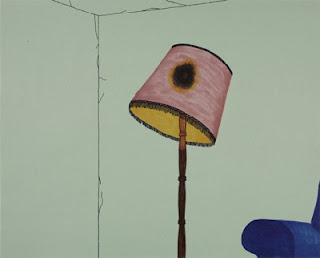
My favourite, however, was this image of a lamp, called New Years Eve. It made me think of how our homes are largely hollow, and we make them our own with our things, our stuff... this image is brought beyond a simple line drawing with some simple colour. Although, that lamp has seen better days...

David Rayson


Secondly, I saw Garry Fabian Miller's Time Passage at the James Hyman Gallery. Predominantly featuring darkroom-created photography, I liked these seascape and landscape images. I always enjoy seascapes because they're both abstract and specific - they could be anywhere and everywhere but are always somewhere.

Garry Fabian Miller

Garry Fabian Miller

Garry Fabian Miller

Finally, I saw Sara Haq's landscapes at Alexia Goethe Gallery. Sara travelled overland from London to Phuket, and this exhibition showed snowy, desolate landscapes. I prefered the more abstract images such as these two.

Sara Haq

Sara Haq

Upstairs, a small installation showed 100 images from Sara's trip which I thought were more interesting than the largescale photographs - you really felt the excitement and wonder and minutaie of such an interesting journey.

Sara Haq

Rebeca for Eurovision, again

Wednesday, January 14, 2009

Eurovision-watching is tough. Nevermind a three-hour contest, in the early months of the year, there are hundreds of songs to listen too.

Sadly, I've not heard many great songs lately. Spain, in particular, has been a mammoth task, with nearly 500 submitted songs.

One such song starts slow, like many of the others, and it's just another ballad amongst many.

BUT THEN

Disco beats kick in, and it's Rebeca with her umpteenth attempt at Eurovision, Se Me Olvído. I can just imagine the strutting, heels and hair. Ooh, there's a video - She's flouncing about with some sheets, and romping in a bed with two blokes. (although one of them doesn't seem bother'd).


Actually, I'm not sure this is her Eurovision song... but whatever, it's fabulous.

True or False Tour & London Historic Pubs Crawl

Thursday, January 08, 2009

It was a colleague's birthday yesterday, and we all went on a pub crawl around some of London's historic pubs.

I had been tasked with devising an activity or game to make the night go with a bang. I thought up a True or False quiz, based on an idea by several bees.

Along the route at each pub, we stopped and heard two stories. I enlisted a helper to tell one story, and I told the other. One of us was telling the trute, and the other making it up.

The game was to guess which was which. If answered correctly, you got a prize.

Our route took us from legal Holborn through carvernous bars to religious Blackfriars:

Along the way we heard stories about telescopes, parrots, queens, bishops, mayors, egg-breaking and lots more interesting things. Some true, some false.

Happily, the audience was divided on every occasion as to what was true and what was false, leading to much spirited debate and laughter.

I thoroughly enjoyed devising this and learning more about history and trivia, and happily my colleague did too, sending me this message at the end of the evening: "Thanks so much for being such winning hosts! It was a great evening, beautifully orchestrated."

Finnish song from Ursula Under

Saturday, December 27, 2008

I recently finished reading Ursula Under, a swirling novel which delves deep into the ancestry of a little girl trapped in a well. It's very fanciful, with stories about ancient China, a Swedish Queen and more. Most interesting are the episodes about Finnish migration to Michigan.

A short Finnish song sung by one character caught my eye...

"Life is as hard as the icy rock under the turf, and we slip on it sometimes, and then we get up to find life is as hard as the icy rock under the turf, and we slip on it sometimes, and then we get up..." and she sings it until she is laughing right through her tears."

Happy Christmas!

Wednesday, December 24, 2008

It's Christmas, and I'm in Ireland. Happy Christmas to one and all.


Happy Christmas!

Mama Sweden map, by Joel

Monday, December 08, 2008

I am still continuing to ask European people to draw maps of their country. The latest candidate was Joel, a good friend from Sweden who has since moved back there.

Here's his drawing, emphasising Sweden, his motherland.


Sweden, by  Joel