
Last weekend, I went to Rīga, in Latvia. Despite having my passport, wallet, phone and camera stolen, and the city being covered with a manky brown sand (due to the icy and snowy weather), I enjoyed my trip there and found it to be a very interesting city. Here's why:
An Ace Thing about Rīga:
The place is run by old and middle-aged women. Every museum had them working in them. The bus conductors are middle-aged woman, wearing green cajoules with natty leather handbags for their change.
A Not Ace Thing about Rīga:
These women can be cranky wenches. And one of them was the very epitome of the suburban name Linda.
Ace Thing
All the trams are driven by what seem to be housewives. It is a funny sight. It's like they decided to go to the local Iceland and thought "I'll take the tram and pick up a few passengers on me way".
Not Ace Thing
Latvian people are very respectful while crossing the road. They wait for the green man to appear, even when there are no cars.
Ace Thing
Except for: A young woman, long legs, short skirt, white boots, puts one foot in front of the other, glances briskly and takes to crossing the road like she was a supermodel-better-than-you.
Not Ace Thing
Not only The Old Ladies, but all the faces in Latvia seemed very dour, very sad.
Ace Thing
Cheekbones.
Not Ace Thing
Awful hair: bad Russian blonde dye jobs.
Ace Thing
Cafés, restaurants and juice bars were all excellent. I particularly liked Sula Enerģija and Café Vanille. All the apple juice you could drink!
Not Ace Thing
The bars seemed to be very quiet and unatmospheric. Very few people talked to me whilst I was there, sitting alone. Any conversation I did have was on a very basic level (weather, country etc.) - not at all like in Poland.
Ace Thing
Vodka in the supermarket was cheap as chips.
Not Ace Thing
Vodka in the bars was comparitively expensive.
Ace Thing
Homewares shops selling all kinds of funky knick-knacks and house accessories were excellent. As was Jana Seta, a bookshop with ahuge relief globe on the wall.
Not Ace Thing
Clothes shops, by comparison, were not.
Ace Thing
In XXL, the best gay club in town, a sight to behold was a young twink, wearing a tight white vest, barely-there trackie bottoms and sheer pants taking to the dancefloor and to the pole-dancing podium with vigour.
Not Ace Thing
The (other gay) nightclub Purvs, whilst hilariously named, was utter rubbish by comparison. (It means 'swamp' in Latvian)
Ace Thing
In XXL, the best gay club in town, a man danced like Renars Kaupers, from (Eurovision 2000) band Brainstorm. It was fantastic to know that he is not the only Latvian to dance this way.
Not Ace Thing
You can really see that the most popular form of dancing is lap- or pole- with sex tourism and stag-nights the order of the night.
Ace Thing
The funniest sight of the weekend was an little old lady standing outside a church door wearing a big fur coat, fluorescent green woolly hat and big Jackie O sunglasses. Comical.
Rīga
Thursday, February 02, 2006
Place Quote: Madagascar - ban on foreign goods
Sunday, January 15, 2006All foreign goods have been banned, by President Didier Patsiraka, as part - his supporters say - of a harsh but wise campaign to force the Malagasy to become self-sufficient in manufactured goods.
- Dervla Murphy, Muddling through in Madagascar, p. 42
Place Quote: Madagascar non-drinkers
- Dervla Murphy, Muddling through in Madagascar, p. 124
Small world
Wednesday, January 11, 2006I went to Oslo, and was chatting to a guy from California who (randomly) had been chatting online to my living-in-Edinburgh Californian friend's Norwegian flatmate.
I was in the sea in Barcelona and heard my name being called. It was the flatmate of a friend.
I was getting my lunch in central London. I saw a man who I had seen playing a guard in Measure for Measure in Cork 4 years ago.
Cork, 2005
Monday, January 09, 2006In 2005, Cork was the European Capital of Culture, a venture which has been both praised and criticised. Culture, however, does not seem to be the lasting change in Cork this year. Rather it's commerce. Throughout the city, developments are continuing apace, with the skyline littered with cranes.

Buildings such as Guy's Building on Cornmarket Street - once a stationery printers - are under renovation. Guy's Building is set to become a hotel and shopping centre. Nearby Cornmarket Street is the location of a weekly market, how these two locations will co-exist?

Affluence is becoming even more noticeable in Cork: the under-26-year-olds who are buying houses, the steady stream of everyone into Brown Thomas (once the reserve of only the fabulous). Cork even has its own socialite magazine, Cork Now.

Cork City Council betrayed themselves with a sign I spotted which had been removed when I went back to photograph. It read:
Shopping Friendly Pedestrian Zone.
Not Pedestrian-Friendly Shopping Zone, then?
One new development is the inappropriately named Camden Wharf - Camden, London does not have a Wharf. 'Camden Wharf' is on Camden Quay, Cork. It is not a Wharf.

Cork City Council are very excited and keen to press ahead with their plans to rejuvenate, gentrify and 'tart up' Cork's dockland areas. New hotels such as the Clarion have already begun trading, with this new wharf-style-decking-area. Does this really sit within the culture that Cork has, its pubs, its hotels?
Having seen these sights, I began to question the city and its relatively rapid accumulation of wealth.

My journey home showed that Cork still had spirit. In Centra, I overheard a conversation between a drunk man and his friends and the Polish woman behind the counter. He was asking her where she was from:
"Warsaw."
"Ah, Warsaw, I was there... it's a lovely city, great place."
"Yes, it is."
"You'd miss it being here."
The next morning, I saw a sign in another shop with the words for 'Happy Christmas' written in English, Irish, Italian, Hungarian, Polish, Lithuanian and Japanese - each language corresponding to a staff member in the shop.
Cork seemed, in small ways, to be embracing the changes, rather than shunning them.
Further evidence of this was to be found in The Immigrant newspaper, produced monthly by the Irish Eastern Europe Association. The jobs section of the paper had numerous opportunities not just in Cork city but in county towns too. Equally prevalent in the paper were discussions and advice on employment rights.

But, in Cork, perhaps the most visibile arrival is a bar: Bialo Czerwoni is a new Polish bar in the city. The name translates into The White and Red - the colours of both the Polish flag and the Cork flag.


Despite these new identities, Corkonian's identities seem stronger. The carpark area off White Street has long been tagged with graffiti. This is the first time I have seen graffiti that specifically addresses Cork and Ireland. Roy Keane, a "local hero" in Cork, is pictured. Roy, is seen by many as the model of strong, stubborn, Cork manhood.


Despite all these changes in Cork, I couldn't help think 'plus ca change, c'est la meme chose'. This ad for the Irish Times plays on the Irish sense of Catholic guilt, of parochialism and of conformity. While there has been some erosion to these, they still remain strong - strong enough to drown out the new voices and new identities in Cork.

Adrian meets Richard X
Thursday, December 15, 2005Last night, I met Richard X, uber-producer. This is how it went.
*A slinkly bounces over*
A: Hi!
X: Hello.
A: drunken ramble, flyer, ramble, ramble, ramble, Contact, ramble, ramble, YOUR FACE!, ramble, ramble, Europop, ramble, ramble.
X: Where are you from?
A: Ireland.
X: Ah.
*A bounces off*
Place Quote: Australia's hidden racism
Saturday, December 03, 2005With Australia, it's always been a very devious kind of racism, it's always been well hidden. Whereas in South Africa, it's our there. It's in your face. It's blatant. The thing that's sold overseas - y'know, wonderful down-under country of sun, koalas and kangaroos... this land is drenched with blood.
- from Planet Ustinov, TV show
Place Quote: Cody - Buffalo Bill & Jackson Pollack
The people of Cody, in one of the more desperate commercial acts of this century, bought Buffalo Bill's birthplace and re-enacted it in their town. But they are lying through their teeth when they hint that he was a local. And the thing is, they have a talented native son of their own. Jackson Pollack, the artist, was born in Cody. But they don't make anything of that because, I suppose, Pollack was a complete wanker when it came to shooting buffalo.
- Bill Bryson, The Lost Continent, p.244
Place Quote: USA - Route 1
By the 1960s, Route 1 has become too congested to be practical - a third of all Americans live within twenty miles of it.
- Bill Bryson, The Lost Continent, p.139
Place Quote: American natural beauty
America has never quite grasped that you can live in a place without making it ugly, that beauty doesn't have to be confined behind fences, as if a national park were a sort of zoo for nature.
- Bill Bryson, The Lost Continent, p.86
Gdańsk
Friday, November 25, 2005
I spent two days in Gdańsk in Poland last weekend. Flying in over the city, it looks like a bizarre mix of industrial landscape and a chocolate box, with the old part of the city standing apart. Gdańsk's Lech Wałesa airport is a very small airport, suddenly made popular by cheap Ryanair and Wizzair flights. Airports are typically boring, so it was quite amusing and surprising to see half the waiting crowd jump up on the luggage conveyer when it stopped, scrabbling around for their bags.
I took the B bus to the centre of Gdańsk, looking at the cold, pale Polish faces and men in funny hats. The buses in Gdansk are the logical epitome of a bendy bus: two smaller buses welded together with some plastic stuck in between. The cars on the road seemed a mixture of modern and hilariously-stereotypical Ladas.

I stayed at the Mercure Hevelius Hotel which, at about 17 storeys high, was unmissable. The building itself looks quite incongruous next to the old city and the service was similiarly typically un-Polish with polite but cold staff.

The Old City (Stare Miasto) of Gdańsk is small, so small I walked to the other end of it without realising. Sadly, most of the old city closed on Saturdays at around 2 or 3, so I didn't get to really appreciate it.
Having left my camera at home, I had hoped to pick up a disposable camera - sadly the few shops I looked in did not have any. I began to wonder where I had come to - was there going to be anything to do?
As I wandered a little more, I noticed some cafés and restaurants. They didn't appear to be open but the lights were on. I quickly realised that despite the large, heavy wooden doors being closed, the establishments were actually open. It is cold there, these doors make sense.
I settled into a coffee shop on the main street (Ulica Długa). Cafe Ferber is a stylish, modern venue with red walls and interior. I sat in the warm, drinking tea with rum (the Irish coffee option felt too clichéd). Tea with rum could make me overcome my apathy towards tea.
As I read the paper, I found the words for 'Saturday' along with 'ukraińskiej' and 'koncerty'. I surmised from this that a Ukrainian folk concert was taking place. I asked the waitress who recommended that I should go and called me a taxi. So, onwards to a large hall-cum-nightclub.
The first few acts included a three-piece girls+guitars band playing jaunty, sing-a-long songs. And everyone was singing along - within the first few bars being played, the dancefloor was full of young couples dancing formalised, traditional dances. Next came some rapping kids - comedy rap, I think - mixing their own raps, Limp Bizkit and Ruslana. Odd but amazing. Following these was some sketches (not a notion what they were about). Then came a 7-piece ska band with added accordion and sax. They were amazing, and I only wish I could understand who they were so I could get a CD.
I left the concert at a lull, when a band fronted by a hoary old rocker but with younger accompaniment took the stage. (It was quite clear this old man fancied himself a lot and continuously changed his backing as Nobody Was Ever Good Enough For Him.)
I went to Sopot (one of the three cities which make up the Trojmiasto area), after something of a debacle getting a train ticket... to Faktoria, Gdańsk's only (functioning) gay club (the only other club allegedly being a mafia front).
So I quickly gave up on dancing and began talking to all and sundry (my evening being fully fuelled by local vodka Źubrówka and apple juice). I met lots of interesting people: an American guy who had lived in London and Berlin, a local Polish guy now living in London, a half-Polish, half-Papua New Guinean guy and his Swedish boyfriend. Everyone was incredibly friendly and chatty.
I stumbled home to my hotel, looking the very epitome of the drunken Irishman, at about 7.
Sunday, I woke and did some shopping. My stomach soon needed food, so I went in search of an open restaurant in the old city. I found Bistro Kos. The menus were only in Polish so once I
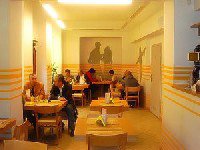 established that what I was ordering was not fish, I waited for my surprise meal. The plate that came was rectangular, about twelve inches by eight and full of food. I had a spicy chicken dish and potato chips and lots of salads and dressings. It was gorgeous. From there, I went to a supermarket to stock up on vodka and then to another coffee shop (The Daily Cafe on Ulica Długa) where I had a hazelnut shake (again a surprise order!).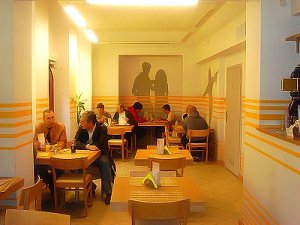
I spent Sunday evening in Sopot. Sopot is definitely livelier than Gdańsk with much more bars and restaurants and would thus seem an altogether better city to be based in (although it is very easy to get there from Gdańsk on the local commuter trains which run all night).
 Sopot the best place to live in Poland with its residents the 'happiest' in Poland and it was easy to see why, especially in summer with a beach on your doorstep.
I went to Soho Bar, a gay-friendly bar (so called as gay people run it). It was very quiet but I would imagine is great fun when in full swing. Its one toilet had a mirrored ceiling which was certainly interesting.
Maybe it's the drink talking but it's a good metaphor for Gdańsk: harsh, but with glimmers of beauty and fabulousness.
All in all, I thoroughly enjoyed my two days in Gdańsk. The city itself is a little quiet and strung out for full on tourism but with a little delving, interesting and fun areas can be found. And vodka is cheap as. What more could you ask for?!
New Direction
Thursday, November 24, 2005Hello,
Welcome to my new blog. On here, I'll be holding forth about travel, music, books and all manner of wonder that pops into my brain.