Showing posts with label statue. Show all posts

Statues of people with disabilities

Wednesday, May 13, 2026

Changing trains recently at Šiauliai in Lithuania, I noticed something that I don't think I've seen a lot before.

On the platform, there is a statue of Stasys Nosys on a plinth, depicting his visible disability.

Stasys Nosys statue, Šiauliai 

Stasys Nosys (1905-1976) was a strongman and bodybuilder. In 1926, he lost both of his legs in an accident. He continued his training and performed in circuses with feats of strength, like breaking stones apart with his fist or lifting up a truck. 

There was false propaganda in the Soviet Union that there were no people with disabilities, and thus  Stasys Nosys was prohibited from his circus work.

I then started thinking whether I had seen statues depicting people with disabilities.

Alison Lapper sculpture, Abxbay, Wikimedia Commons

I remembered the sculpture of Alison Lapper that was displayed on the Fourth Plinth in Trafalgar Square between 2005 and 2007 (and is in Venice in this photograph). Somehow, I didn't think of this as a 'commemorative' statue, as Alison Lapper is still alive.


Beethovenhaus, Bonn


I also thought of this statue of Beethoven, at the museum which now occupies his home in Bonn. His disability is not visible, but perhaps it is still present in the sculpture?

What other examples do you know of statues depicting people with disabilities?

Seeking statues of women

Sunday, March 01, 2026


Considering women make up around half the population, there is a huge lack of women on statues.

In many towns and cities, it's often the case that there are very few women on statues. Or very few named women on statues, as it's often the case that statues with female forms are abstract or mythological figures.

I wrote about there being so few statues of women in cities and towns across Europe in 2019 for Europeana, and recently published a gallery showcasing images of women on statues. Perhaps in the six years since that first blog, things have gotten a little better.

Since writing that blog, my eyes are now very open to statues that commemorate women. I spot them, photograph them, and upload them to Wikimedia Commons. See here for all the photographs of statues I've shared.

Here are some examples from various countries.

Armenia


Austria


Belgium


Canada


Czechia


Germany


Hungary


The Netherlands


United Kingdom


Statues and sculptures in Tournai

Friday, October 03, 2025


Last August, I was travelling from France to Belgium, and had to change trains at Tournai. It was somewhere I had never heard before, but looking it up, I found it is one of the largest cities in Wallonia.


So I decided to take a look around. And what a pretty city! It was a warm sunny day when I was there, so the city shone and looked its best.

What I noticed most were the many statues and monuments around the city. So, I thought I'd write about them.

Jules Bara

One of the first statues encountered after the Tournai train station is this impressive monument to Jules Bara. He was a 19th-century Belgian statesman and liberal politician who was born in Tournai. He served in numerous governments and was a Minister for Justice - but that doesn't stop people in Tournai dressing him up during carnival.

Adolphe Leray

Heading toward the river Scheldt, on Rue de Becquerelle, there is a memorial fountain to Adolphe Leray.


Adolphe Leray was a poet and songwriter born near Tournai in 1810. He wrote popular songs in French and Picard dialect. The bust from this fountain was stolen in 2003 and finally replaced many years later in 2017.

Barthélémy Dumortier


Barthélemy Dumortier was a botanist and zoologist, as well as a politician. Born in Tournai in 1797, he took part in the Belgian revolution in 1830. Three years earlier, he had published Flora Belgica, cataloguing the nation's plants.

This monument was erected in 1883, the work of sculptor Charles Fraikin. There is also a bust of Dumortier in the National Botanic Garden of Belgium in Brussels.

Christine de Lalaing


It's rare to find a statue depicting a real-life woman. This monument to Christine de Lalaing takes pride of place in the centre of the Grand Place in Tournai.


Christine de Lalaing, the Princess of Epinoy, led the defence of Tournai against Spanish troops during a siege in 1581. She was the wife of Pierre de Melun, the governor of Tournai, who had left for an attack on another city. In his absence, Christine de Lelaing organised Tournai's resistance and took part in battles on the ramparts. The siege lasted two months and ultimately proved unsuccessful. Christine de Lalaing was injured, dying several months later.

Her bravery earned her the respect and thanks of every citizen. This monument was erected in 1863, the first in Walloonia which was dedicated to a woman.

Louis Gallait


Louis Gallait was a 19th-century artist, born in Tournai in 1810, who studied in Tournai, Antwerp and Paris. He was mostly known as a painter of portraits and historical paintings.

He is honoured with a statue in the centre of the Square Paul Bonduelle, itself named after an important architect.


Angels in America

Sunday, December 07, 2014

Whenever I sit in a window seat in a flight, I always think of a scene in the TV miniseries of the play Angels in America (first broadcast 11 years ago today!) in which a character - Harper - sits in a window seat (go watch it, it's brilliant!).

And as one of my recent flight was to New York, this led to remember more scenes from the play set in and around Manhattan - including the memorable final scene set at the Bethesda fountain in Central Park.


This led me to go in search of more Angels in America, dotted around New York.


This angel above holding a globe is part of the large monument at the centre of Columbus Circle.


This small angel - perhaps more a cherub or maybe just a little baby - is one of a pair perched on a lamppost on Grand Army Plaza right by Central Park. Take a look: https://goo.gl/maps/sjyrL


These two angels are to be found on the bronze base of a flagpole outside the New York Public Library on Fifth Avenue.


These two angels are upon the Federal Office Building at 90 Church Street, just near Ground Zero.

But many angels I thought I had found actually turned out to be eagles - the symbol of the United States - like this above Grand Central Terminus.


Talking Statues in London

Tuesday, August 26, 2014

At the weekend, I spent a day listening to London's Talking Statues.

This is a new project where a number of statues talk and tell their story to you, via your phone.

I love seeing statues, I have a pinterest board dedicated to my favourite statues. I've often looked at statues and wondered "who's that dude, why's he here?" (more often than not, it is a man).


So this project really appeals to me.

Doubly so, as it's part of a wider Digital R&D project from the Arts Council, Arts and Humanities Research Council and Nesta: essentially a way to have arts organisations think differently and try out digital tools. So: it's my day-job at the Horniman.


Over the course of the day, I visited twelve of the statues. Here are some thoughts.

  • I loved it. I found it great to hear from (some of) these characters, especially the historic people. Words to describe: fascinating, illuminating, funny, heartwarming, imaginative, informative. I learned things I never knew about Queen Victoria, Rowland Hill and John Wilkes.

  • I don't think the talking statues are designed to be seen the way I did, by visiting lots in one day. It works best as serendipity, you see a statue and then the plaque telling you to hear the statue. That said, something connecting them would be good too - a hashtag or something on the plaque to give the sense that there are more to see.
  • For me, the talking statues worked best when the statue was a real person (or animal). The fictionalisation of artworks didn't really appeal to me. But I loved hearing from the 'real' Queen Victoria, from Brunel or Rowland Hill.
  • The technology worked well for me. I can't use NFC tags (my phone doesn't like them) but the QR codes worked fine, as did typing in an address (I used that one most).
  • The NFC tag on the plaque is a symbol and the word 'Tap'. It was fascinating watching how people interpreted that. They tapped the tag with their feet, with their fingers, but never with their phones. Some people tapped repeatedly. (It reminded me of a time I saw a woman at the Horniman literally speak a question into an iPad as it had the wording "Ask a question" [we meant 'type in']).
  • Tech fans: the 'statues' don't actually phone you. It all connects to mobile-optimised websites which cleverly package streaming audio to look and feel like a telephone call.
  • At several of the stops, I got into conversations with other people about the technology, about the talking statues. It was quite enjoyable sharing these little moments.
  • Even when I was alone, my presence listening and looking at the statues encouraged other people to look at the statues that little bit more.
  • Public artworks are quite unusual in a museum sense. They often have no interpretation whatsoever.
  • My favourite: without doubt, Queen Victoria. Two of her statues are narrated, both by Prunella Scales. A wonderful actress playing a wonderful character.


Roma twitter

Friday, August 14, 2009

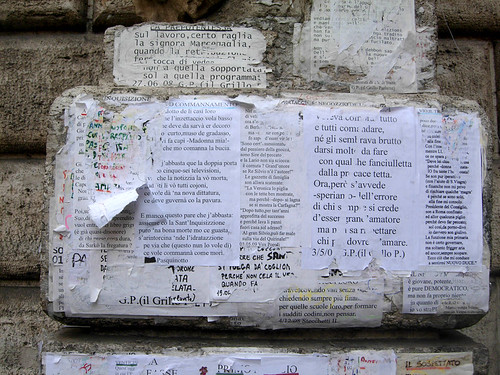
When I was in Rome, I made a special trip to see a small, almost ignored statue in the corner of a small square. It's called Pasquino, and is in Piazza di Pasquino.

The ancient statue, which probably dates to the 3rd century BC, was dug up when paving part of Rome. In 1501, on April 25, Saint Mark's Day, a cardinal draped the statue in a toga, and attached epigrams in Latin to it.

A custom soon arose for those who wanted to criticize the Pope or individuals in his government to write satirical poems in broad Roman dialect and attach them to this statue.

Pasquino was, thus, Rome's first talking statue (and many more appeared), and a neat Roman-style Twitter. Even today, satirical notes are attached to the statue.

Pasquino statue, Rome


Pasquino statue, Rome


Notes attached to Pasquino statue, Rome