
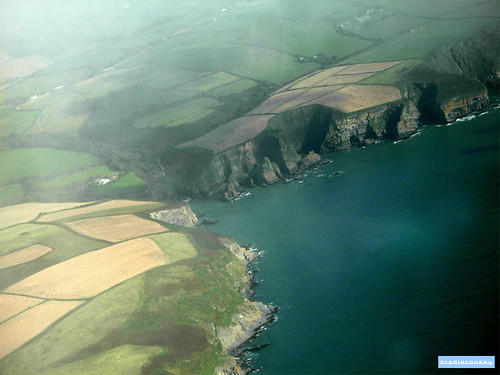
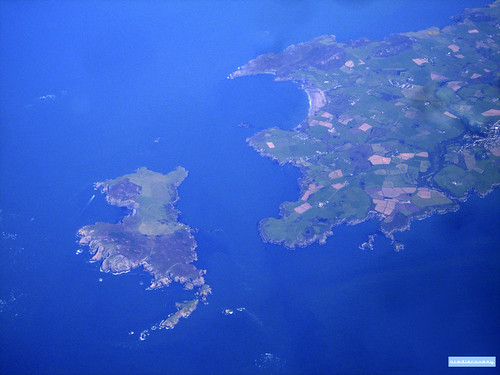
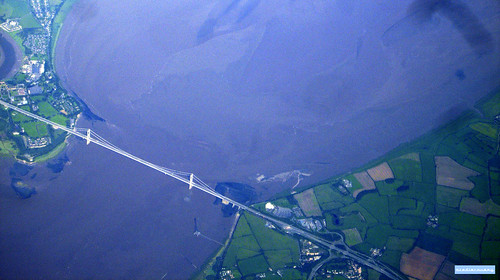
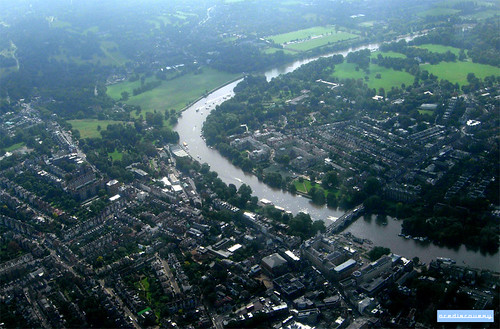
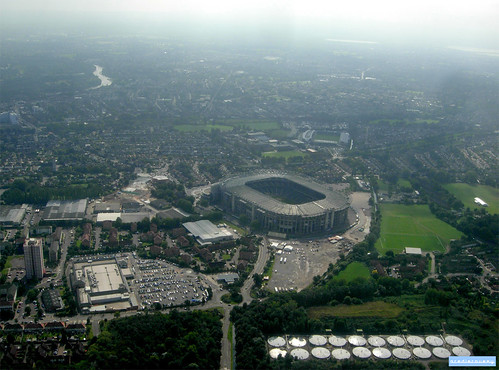
I've been flying back and forwards between Cork and London for nearly 6 and a half years now. Inspired by my last post with google maps screenshots of geographical landscapes, here are a variety of aerial photographs taken on my many flights between Ireland and the UK.

Showing posts with label Cork. Show all posts
Showing posts with label Cork. Show all posts
Cork to London, from above
Saturday, January 14, 2012The Gearagh
Friday, January 14, 2011
I grew up near The Gearagh, a unique part of County Cork, although I never really knew much about it. My teachers never talked about it in school, odd when you consider it was a mere mile from the school.
The Gearagh gets its name from An Gaorthadh, the wooded river. It is what remains of a submerged forest and community.
In the 1950s, to facilitate the building of two hydroelectric dams, the trees in the eastern part of Gearagh were cut down, and the area was flooded with around 60% of woodland lost. Tree stumps remain, sometimes submerged, sometimes above the water line.
In addition to my photography, take a look at this great aerial photograph of the Gearagh.
The People's Republic of Cork
Wednesday, March 17, 2010Today is St Patrick's Day, the day I and millions of others celebrate being Irish.
But! Being from Cork is even more important than being Irish. Cork, or The People's Republic of Cork, is Ireland's independent capital, with the rebel spirit leading us on.
I took these photos in Cork several years ago for a photo-essay on the "People's Republic of Cork". People from Cork, and further afield, wearing People's Republic of Cork t-shirts, a trend embodying the city's unique spirit.
See the full set of photographs here.
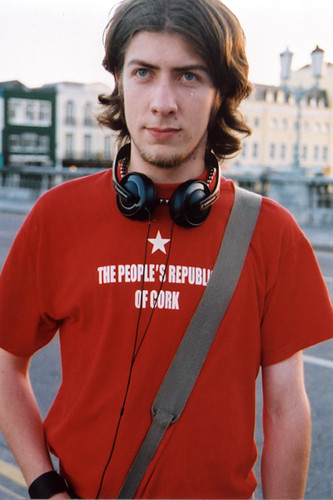
Eoghan, from Cork

Tina, from Cork

Peter, from Cork
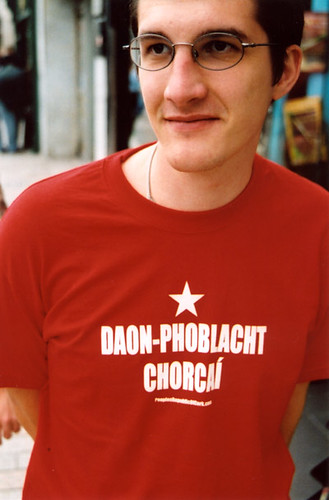
Pierre, from France

Luis, from Portugal
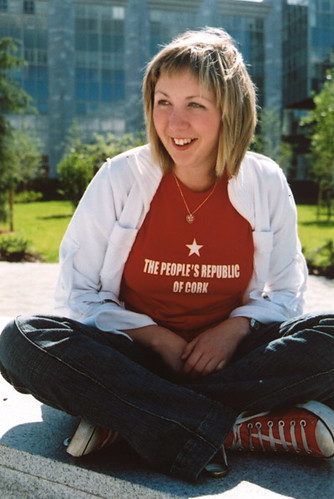
Elaine, from Offaly
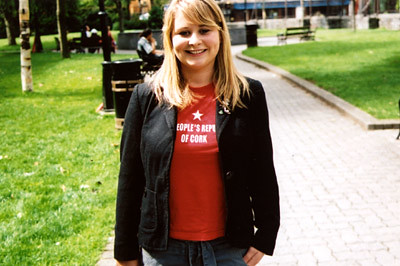
Barbara, from Cork
Cork, 2005
Monday, January 09, 2006For Christmas, I went home to Cork. Perhaps because I'm away, the changes in Ireland show much more starkly than if I were at home, lulled by a gradual process of change.
In 2005, Cork was the European Capital of Culture, a venture which has been both praised and criticised. Culture, however, does not seem to be the lasting change in Cork this year. Rather it's commerce. Throughout the city, developments are continuing apace, with the skyline littered with cranes.

Buildings such as Guy's Building on Cornmarket Street - once a stationery printers - are under renovation. Guy's Building is set to become a hotel and shopping centre. Nearby Cornmarket Street is the location of a weekly market, how these two locations will co-exist?

Affluence is becoming even more noticeable in Cork: the under-26-year-olds who are buying houses, the steady stream of everyone into Brown Thomas (once the reserve of only the fabulous). Cork even has its own socialite magazine, Cork Now.

Cork City Council betrayed themselves with a sign I spotted which had been removed when I went back to photograph. It read:
In 2005, Cork was the European Capital of Culture, a venture which has been both praised and criticised. Culture, however, does not seem to be the lasting change in Cork this year. Rather it's commerce. Throughout the city, developments are continuing apace, with the skyline littered with cranes.

Buildings such as Guy's Building on Cornmarket Street - once a stationery printers - are under renovation. Guy's Building is set to become a hotel and shopping centre. Nearby Cornmarket Street is the location of a weekly market, how these two locations will co-exist?

Affluence is becoming even more noticeable in Cork: the under-26-year-olds who are buying houses, the steady stream of everyone into Brown Thomas (once the reserve of only the fabulous). Cork even has its own socialite magazine, Cork Now.

Cork City Council betrayed themselves with a sign I spotted which had been removed when I went back to photograph. It read:
Shopping Friendly Pedestrian Zone.
Not Pedestrian-Friendly Shopping Zone, then?
One new development is the inappropriately named Camden Wharf - Camden, London does not have a Wharf. 'Camden Wharf' is on Camden Quay, Cork. It is not a Wharf.

Cork City Council are very excited and keen to press ahead with their plans to rejuvenate, gentrify and 'tart up' Cork's dockland areas. New hotels such as the Clarion have already begun trading, with this new wharf-style-decking-area. Does this really sit within the culture that Cork has, its pubs, its hotels?
Having seen these sights, I began to question the city and its relatively rapid accumulation of wealth.

The by-products, generally speaking, of this seem to be the increased lack of patience and, dare I say, increased violence.
Having spent a night out in Cork, standing amongst the many people streamed out onto Tuckey Street, I suddenly felt that I shouldn't be there. Having watched three men fight each other for no apparent reason, and watching a young woman shout her head off, I decided I would go home.
My journey home showed that Cork still had spirit. In Centra, I overheard a conversation between a drunk man and his friends and the Polish woman behind the counter. He was asking her where she was from:
"Warsaw."
"Ah, Warsaw, I was there... it's a lovely city, great place."
"Yes, it is."
"You'd miss it being here."
The next morning, I saw a sign in another shop with the words for 'Happy Christmas' written in English, Irish, Italian, Hungarian, Polish, Lithuanian and Japanese - each language corresponding to a staff member in the shop.
Cork seemed, in small ways, to be embracing the changes, rather than shunning them.
Further evidence of this was to be found in The Immigrant newspaper, produced monthly by the Irish Eastern Europe Association. The jobs section of the paper had numerous opportunities not just in Cork city but in county towns too. Equally prevalent in the paper were discussions and advice on employment rights.

But, in Cork, perhaps the most visibile arrival is a bar: Bialo Czerwoni is a new Polish bar in the city. The name translates into The White and Red - the colours of both the Polish flag and the Cork flag.


Despite these new identities, Corkonian's identities seem stronger. The carpark area off White Street has long been tagged with graffiti. This is the first time I have seen graffiti that specifically addresses Cork and Ireland. Roy Keane, a "local hero" in Cork, is pictured. Roy, is seen by many as the model of strong, stubborn, Cork manhood.


Despite all these changes in Cork, I couldn't help think 'plus ca change, c'est la meme chose'. This ad for the Irish Times plays on the Irish sense of Catholic guilt, of parochialism and of conformity. While there has been some erosion to these, they still remain strong - strong enough to drown out the new voices and new identities in Cork.

Subscribe to:
Posts (Atom)