
There are only two weeks to go to Eurovision. How exciting! I've decided to embrace all things Norwegian. So for the next few weeks, I'll be tweeting a lovely Norwegian word every day (stealing an idea from the wonderful World of Chig's Serbian countdown), and compiling them all here.
tausheten
meaning the silence
fjellet
meaning mountain
jubileum
meaning anniversary
strømme
meaning flow
sønninger
meaning waves
strålende
meaning brilliant
lykkerus
meaning drunk with happiness
skog
meaning forest
kjekk
meaning handsome
solstreif
meaning sunlight
moteriktig
meaning fashionable
kjærlighet
meaning love
ballongen
meaning balloon
Showing posts with label language. Show all posts
Showing posts with label language. Show all posts
Let's all speak Norwegian.
Tuesday, May 11, 2010Vroom with a View
Thursday, May 21, 2009While on holiday, I like to read something about the place I'm visiting. In Italy, I read Peter Moore's diverting Vroom with a View
Some facts I gleaned were:
- Vespas were named after the Italian for wasp.
- Vespas were designed as transport for ordinary Italians still reeling from the Second World War. The cost of a Vespa was, however, just a bit less than that of an average Italian salary. So, Piaggio (the manufacturer) came up with the idea of allowing their customers pay in instalments, which was a radical concept for the 1950s. Piaggio was the first European company to try this, and it paid off with more than half a million Vespas sold by 1953.
- The Italian phrase cugi - which means tacky or cheesy - comes from the phrase cugini di campagna 'your country cousins'
Hiberno-English and Irish words
Tuesday, March 24, 2009As it was St Patrick's Day last week, many of my recent conversations have been about Ireland and Irish-ness, with accent nearly always the most popular subject.
I was reminded of a print out I had with 22 examples of Hiberno-Irish dialect - and while I agree with most of the examples, some are very 'stage leprauchan'.
The examples are:
1. Is it Commerce he's studying in College?
2. Peter asked John was he at the match on Sunday and did he see Sheila there.
3. They spoiled her as a child and she's a very bold girl in school.
4. How long do you know Margaret?
5. It's a right mess he's after making of it.
6. I saw two sugawn chairs and a pine table for sale.
7. My brother learned me how to drive.
8. Did you ever hear her talking about anything only study?
9. I caught a fine salmon but the rod broke on me and it got away.
10. He has no sense for an eighteen year old: I saw him out walking yesterday without a coat and it raining.
11. He's hopeless to study now: he usen't be like that when he was younger.
12. Is it Sunday the match is on?
13. See is it on the shelf.
14. Are you going to town? I am. Is it a message you are wanting?
15. He's dead sound, a real sincere young fellow altogether.
16. We were here ages before he came.
17. How can she study with the state she's in?
18. I was just after putting down the phone when I realised I forgot to tell you about the party.
19. Her face was all swollen with the mumps.
20. I do be falling over that yoke about ten times a day.
21. I'm on the pension nearly three years now.
22. Every morning I do be after missing the bus.
Numbers 1, 5, 9, 12 and 14 use an odd-for-English sentence structure, mainly (I think) as it comes from a direct translation from Irish (Gaelic).
3, 11, 14 and 20 have words for other words which may be specific to Hiberno-English: bold for naughty, the contraction usen't, message for shopping and yoke for thing. These are my favourite, and there are many more, such as:
press for cupboard
'give out' for 'tell off'
'copy book' for 'note book / jotter'
Observations on Portugal
Tuesday, February 17, 2009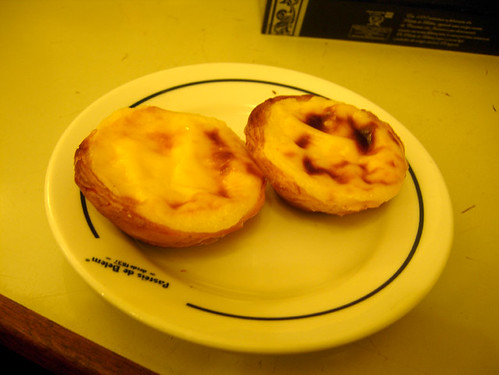
- Itinerant Londoner was right - the food in Portugal is disappointing. Try as I might, I did not find mijas on the menu, and instead was left with oily, greasy and largely flavourless food. Once or twice, I did think "yes, it's stodge, but glorious stodge" a la Nigella, but that was rare.
- It struck me that while the high-end restaurants may have brilliant food, more commonplace, everyday cafés and such churned out basic, unadorned food. A bit like the food at an Irish wedding - plain and simple, nothing that'd scare that aunties and uncles.
- Cakes, buns and tarts, however were divine, especially the pasteis de nata and pasteis de Belem (above).
- There are a lot of pharmacies in Portugal. Lisbon seemed to have one at every turn.
- My favourite of Lisbon's gay bars were Setimo Ceu in Barrio Alto - ace music, friendly staff and a cool magazine-collage wall - and Max in Principe Real, unadorned, unpretentious and friendly.
- My favourite Metro stop (in Porto) was Estadio do Dragao - simply for the phlegmatic tongue-twisting way it is pronounced. In Lisbon, I quite liked Marques do Pombal as it sounded like Marques do bumhole. (Mature, I know)
- My very favourite things were: azulejos and seeing Cabo da Roca - more of this later.
Subscribe to:
Posts (Atom)