Showing posts with label placenames. Show all posts

Europe in USA

Wednesday, July 16, 2014

For many years, I've been interested in the way towns, cities, villages and more in the USA are named (I wrote about in 2010).

Reading the article which inspired that blog, I realised that nearly all of Europe was accounted for in American placenames.

So I set about making a map of some European place-names in the USA.


Sadly, there isn't a place for every country in Europe, though sometimes there are more than one, e.g. Norway, Kansas, Norway, Iowa and Norway, Maine, so I chose the place which sat best on the map.

In some cases, a country name is not accounted for, but the capital city is e.g Vienna, Georgia or Sofia, New Mexico.

And occasionally, you really can't be sure that the European placename is the inspiration - e.g. Turkey, North Carolina or San Marino, California

I'm fascinated by the breadth and number of places with names inspired by Europe. I suppose the next step is to start visiting them!

Name the Olympic neighbourhoods

Tuesday, April 12, 2011

London 2012 Olympic stadium from above

I like placenames, and I particularly like knowing why somewhere is named how it is named. I like that Argentina is named after silver, that Pakistan is an acronym and that Elephant & Castle has lots of stories to its name.

So I was excited to discover that the London 2012 Olympic Park Legacy Company have launched a competition to name the five Olympic neighbourhoods which remain once the games have ended.

They are inviting the public to suggesting names for the five new neighbourhoods in Tower Hamlets, Hackey and Newham. You can enter until May 18.

My suggestions were:
  • Neighbourhood 1: Previously, this are was used for potting sheds; during the Olympics this will be the site of the basketball arena. I went for Hoopshed.

  • Neighbourhood 2: Previously, White Post Lane ran through here; during the Olympics it will be the Media and Broadcast Centre. I chose Broadpost.

  • Neighbourhood 3: Previously, this area housed confectionery factories and timber yards. After the Olympics, it'll have lots of leisure facilities. I decided on Sweetwood.

  • Neighbourhood 4: This is the site of the Olympic arenas. And as Temple signifies the site of a temple, and Bank is where the banks are, I thought Arena should be where the arenas were.

  • Neighbourhood 5: An area which will be mainly residential, bordered and crossed by canals and the Bow Back River, I chose Bow Waters as the name.

What do you think? Are you entering? What are your suggestions?

Adrian, USA

Friday, November 05, 2010

Adrian, USA

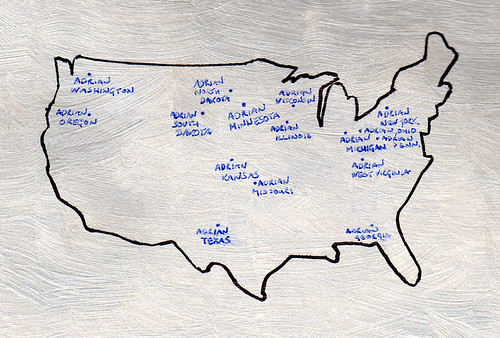
Whilst reading the article on the nomenclature of American towns, I got to wondering about places with my name. It turns out there's quite a few Adrians in America, stretching all the way from New York to Washington. 

The majority of American Adrians are quite small, with no more than a couple of hundred people in each. Some are named after settlers, with one, Adrian, Oregon, named after another Adrian: Adrian, Illinois.

Adrian Minesota, one of the larger Adrians, with more than a thousand inhabitants, was named after the mother of the local railway's directors. She was called Mrs Adrian Iselin, and he was Adrian C. Iselin. So really he named it after himself. The locals, apparently, prefer to believe the town was named after St Adrian.

Adrian, Michigan is perhaps the most exciting of all, with a plentiful 21,000 inhabitants. During the late 19th century and early 20th century, it was known as the "fence capital of the world," as it was where the first successful wire fence was invented. Fancy that. 

On the nomenclature of cities and towns in the United States

Monday, October 18, 2010

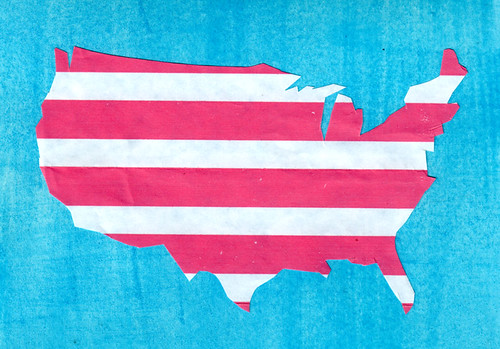
Stripes USA map

I recently found an article from 1885 on JStor with the exciting title On the nomenclature of cities and towns in the United States. It sounded fascinating - I've always wondered why certain cities in the USA were so named.

I was thinking about places I've seen on maps, places like Malta, New York, Zurich, Kansas or Lebanon, Oregon. I imagined fledgling Maltese, Swiss or Lebanese immigrant communities founding new towns and making new lives in a new land.

The actual reason is much more prosaic. Early railway companies and postal companies basically picked names at random or from long lists of places (maybe listed in almanacs)

The article speaks of certain parts of New York state with classic names like Ithaca, Syracuse, or Troy, so named as "a pedantic surveyor-general of the last century took ancient names, at random, out of a classical dictionary to scatter broadcast over this new land".

Years ago, I read Sweet Liberty by Irish writer Joseph O'Connor (brother of Sinead). In it, he travelled around the US, visiting nine towns and cities called Dublin. But despite finding something to write about in each place, he found very little connection to Ireland.

Practically all of Europe is accounted for: from Armenia, Wisconsin to Lisbon, Ohio, from Athens, Georgia, via Vienna, Missouri to Oslo, Minnesota.

These places are not named in the ways we might first think... but they could be, and that's what's brilliant.