Showing posts with label Japan. Show all posts

Circle Lines | Yamanote Line, Tokyo

Saturday, May 09, 2015

Sometimes when I'm travelling, I like to simply sit on a train and watch people near me, places passing by. And what better way to do this than on a circular, loop line.

I like to think that a circular line brings you a 360° view of a place (it's not always the case, but it's a nice idea).

This is the first in a semi-regular series of posts on circular travelling -so if there's a circular loop line where I am, I'll get on board!


Years ago when I visited Tokyo, I spent a few hours travelling around on the Yamanote line.

It's a circular line travelling through most of the major stations in Tokyo, including Ginza, Shibuya and Shinjuku.

As I sat on the train, I took notes of sights I saw and sounds I heard and revelled in the people-watching.

I saw:
  • Green stripes on platform to show where to stand
  • A girl with purple and gold bag and gold shoes
  • The five people opposite me lined up, all asleep
  • A chorus of polyphonic music greeted us at every station
  • Outside offices, and lots of them
  • Huge concrete faceless skyscraper structures at Akihabara
  • A MUJI warehouse
  • A pyramid covered in sparkling lights at Yurakucho
  • Passengers reading books with non-descriptmd plain covers: beige or plain white, some with very simple patterns.
  • The station Mamamatsucho pronunced differently in English and Japanese
  • The monorail to Haneda airport flying over the metro line 
  • A tiny dog in a woman's handbag. She's been on the train for 6 stops ago, before I had noticed
  • Nobody else seems to noticed the dog
  • A grown man reading a comic, showing the words "Here's the world War 1 flying ace returning to the aerodrome"
  • Lots of snorting and sniffing sounds
  • At Ebisu station, the man next to me sleeps and slumps against me
  • A guy whispering into his phone
  • As the train continues around, the dog starts to bark lightly. The woman holds its mouth.
  • The man next to me then notices the dog and pets it
  • A poster in station declares: "Never stop the explaining!"
  • At Osuka station, a man tucks his (dry) umbrella into his trousers. It's half genius, half weird.

World Cup in London: Japan

Sunday, June 20, 2010

Or: サッカー! Football with London's Japanese fans

Japan football fans, London

Yesterday, I watched Japan -v- Holland in the company of Japanese fans.

It was a game of two halves for me: firstly, I went to the Chutney & Lager to watch with people from the Japan Society. But, to be honest, they were all very quiet and didn't have a flag in sight.

So at half time, I moved on to Bincho Yakitori  in Soho where a downstairs room was full of Japanese fans, their friends, and even some Dutch fans.

The Japanese fans weren't taking the game very seriously - every shot against them received a nice applause and a little ripple of laughter. The laughter became chants when Japan pushed forward. One man got the whole room going, chanting Nippon! Nippon! Nippon! Well done that man. More singing and chanting broke out when Nakamura came on.

But, in the end, Japan ended the game in defeat. Not that the mild-mannered fans seemed to mind, they were smiling and laughing just as much as they had been during the game.

Tokyo musicians, Swedish pastoral, Romanian river

Monday, January 28, 2008

This week, I saw three exhibitions:


  • Marco Bohr's photographs of Tokyo riverside musicians at Mummery & Schnell
  • Sigrid Holmwood's paintings of Swedish peasant life at Annely Juda
  • Serban Savu's paintings of contemporary Romanian life at FA Projects

Marco Bohr's photographs of Tokyo show musicians on the banks of the Tamagawa river. The open spaces are the opposite of the modern, neon image of Tokyo. With usual Japanese respect, the musicians practise their music on the river banks, rather than disturb their neighbours who are so close due to Tokyo's density.


Sigrid Holwood's paintings shine with colour: neon yellows, fluorescent oranges and greens. The colour seems at odds with the subject: Swedish rural landscapes and scenes of peasant life. The paintings are alluring - my favourites were the landscapes. I saw them glowing with atmosphere. The colours express the joys of being in the landscape.

The paintings of humans, however, play with reality - many of them were painted in folk museums, so their inauthentic colours match the inauthentic nature of the scenes.

Most of Serban Savu's work saddened me: painted from a distance, and with dull, oppressive colours. They show people on the banks of a river in Romania. The painting above seems to sum this up: the scene looks very jolly, a family or group enjoying a day by the river, a holiday. But the colours have no fun. Perhaps this is to suggest that social life in Romania oppresse, but I found this to be sombre, sad, depressing.

Japan,

Wednesday, January 02, 2008

I asked Tomohiro to draw Japan. He had recently moved from Japan to rural Ireland, and had previously lived in California.

Japan, in his map, is smaller than I expected it to be.

Tomohiro's drawing of Japan

World Song Festival

Monday, January 08, 2007

I recently took part in World Song Festival, an online competition much like Eurovision. Songs are sent from countries around the world, we listen, we judge and a winner is chosen. I liked the idea so much that I decided to help the organiser, Trond from Norway, by designing a website for the competition.

The overall winner was the very, very excellent electro-pop song Gabriel by French singer Najoua Belyzel. The song was a hit in France, going to number 3 in the charts. In 2006, Najoua released her debut album Entre deux mondes, which debuted at 7 on the French charts, and apparently will be promoting herself across Europe in 2007. Ace.

Gabriel is a fantastic electro-ish number with vaguely ethereal, moaning vocals and a grinding chorus which sounds great with its French vocals. The high-point is the ace apres-chorus electrofied break-down.


There were some other ace songs in the festival, here are some of my favourites.

It would be so wrong if I didn't pick the Swede. Nanne Grönvall, the ace rocky schlager star is just great. Having re-invented her look and image more times than I've had haircuts, her latest look says 'big hair, small lady'. 


That small lady totters around on high, high heels, wears skimpy floaty dresses, and kicks and struts with aplomb. She was ROBBED of Melodifestivalen in 2005 with Håll Om Mig, a performance made super-ace by having wind machines ON STAGE. Amazing. She'll be in Melodifestivalen this year with the hopefully bombastic + poptastic Jag måste kyssa dig (I Must Kiss You).

Coming 12th in WSF, Om du var min starts with the stock schlager slow-start, kicks in a beat, and builds to a pumping chorus. Nanne likes a guitar sound, Nanne likes to rock out in a twirling style.


From Japan, Nami Tamaki's Reason is J-Pop brilliance. 

There's a wall of immense sound, parts pop, parts electro and part super-cute Japanese style. The song builds with booms and explosions to its chorus which is an even bigger sound that can barely contain itself for the breakdown. And you just know that the slow parts are just breathers, waiting to give way to even more top pop explosions. As with so many J-Pop stars, Nami Tamaki has released many albums and singles in Japan. This one reached 2nd on the Oricon Charts. It came 6th in WSF.


Elefante are a Mexican band who perform fairly standard Latin rock. I liked their song Mentirosa, simply because it was great Latin pop. It does exactly what you want - has a great catchy chorus, lovely Spanish sounding guitars and harmonies. Elefante seem to be fairly successful in Mexico, with a number of albums and a greatest hits to their name. In WSF, they finished in 36th position.


Jorge Rojas' Busca en tu corazon is 100% pure cheesy, and I can't help but love it. Jorge is Argentinian, and released his debut album there in 2005, from which this song comes. Busca en tu corazon is a deeply heartfelt up-tempo ballad with panpipes, latin guitars and so much pleading with a rousing chorus. It's a real lighters-in-the-air, swaying from side-to-side song and has wonderfully implausible lyrics like "look in your heart if you want to find the road to follow to discover the truth". Fantastic. It was 20th in WSF.


Finally, Dilnaz Akhmadieva is a popstar from Kazakhstan. I always knew there'd be more to Kazakhstan than Borat! Dilnaz sings in the Uyghur language, and has been singing for years, even though she's only about 20. This song, Zolotoy, Zolotoy which could mean Golden, golden is ace. It's got a eastern, ethno-tribal sound mixed with some electro strains and beats. 

If Kazakhstan ever want to be in Eurovision, sign her up now. It finished 23rd in WSF.


Wish I was there

Friday, November 10, 2006

When an idea forms in my brain, I often find myself thinking that I wish I'd thought of it earlier. For instance, I wish I had thought of my map collecting project a year ago, and could have collected maps from my trips to Poland, Latvia, Sweden, Japan etc. This thought came to me again a few weeks ago. We went for a day to Hastings, during the lovely weather of the Indian summer.

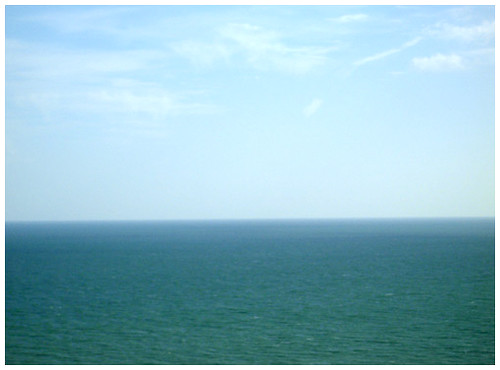
As we walked along the clifftops, I looked out to sea. I was taken by the strong, vivid, complimentary blues of the sea and sky, divided by the horizon. I took some photographs. I was pleased when I looked back at the photographs, but thought that these could have been taken anywhere. There was a universality in the combination of sea and sky.


Seascape: Hastings

I again started to wonder why I hadn't thought of this idea earlier. A framed picture formed in my mind, showing 8 small photographs of the sky and sea, each taken in an entirely different location, yet each with a similar and timeless universality.

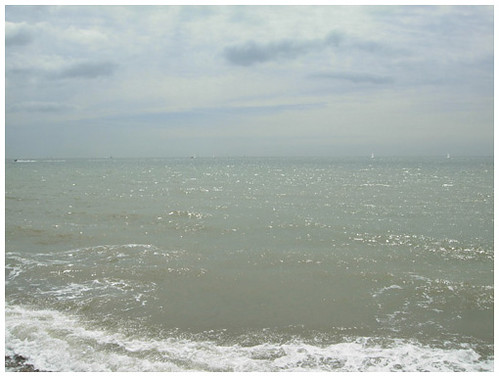
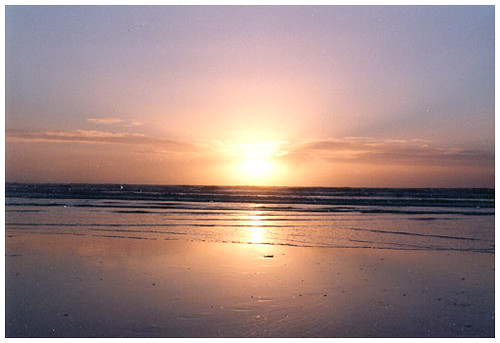
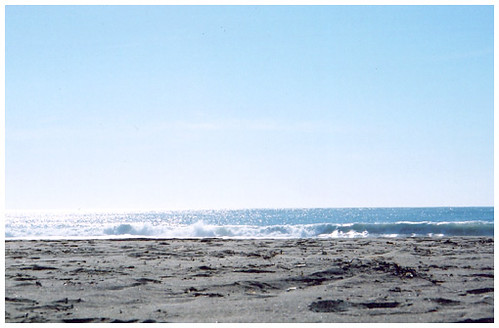
I thought about this some more when I got home, and started looking through my photographs pictures. I found that kernels of this idea had formed, but nothing fully fledged. The photographs below are from Brighton, Barcelona, Japan, Cork, Kerry and San Francisco.

Seascape: Hastings

Seascape: Barcelona

Seascape: Japan

Seascape: Kerry

Seascape: West Cork

Seascape: San Francisco


I love how each photograph could be anywhere (with the possible exception of the photo from Barcelona). There is sky, there is sea. But each photograph is, for me, grounded - that is Kerry, that is Barcelona etc. My memory of these places influences my viewing of the photographs. So while I was disappointed that I had not had this idea sooner, I found that thinking about how the idea traced its way through my previous travels was as rewarding as any ultimate framed picture.

Japan-style

Friday, November 03, 2006

I've spent the past couple of weeks working on this image from my trip to Japan. I put most of these photographs on the blog inMay. I wanted to do something more with them. So I collaged the best photographs together, making a large poster print which I've framed and now adorns my bedroom wall. It measures 30 x 40cm, and is a riot of colour. I'm really quite pleased with it.

I'd like to sell this, and any other image I've done, as prints. So if you'd like to buy a print of this, just let me know by commenting or emailing or any-way-you-can and we'll organise something.


Arigato

Monday, September 25, 2006

I went to see Arigato, a new Japanese film on Saturday, which was part of a short festival organised by the Japanese Embassy.

The film tells the story of a volunteer fireman and his family after the Kobe earthquake of 1995. I've always thought it might be cool to experience an earthquake, but not after seeing this - it just looks bloody scary.

The film continues from its dramatic opening to tell the story of how he takes a leading role in rebuilding the city and then, improbably, becomes a pro-golfer. It's wonderfully warm and funny, which great convincing performances throughout.

I enjoyed it even more as a Japanese film that is not about samurai or manga, but rather a more realistic image. I loved seeing small aspects of Japanese culture - for instance, the formal ways in which "Arigato" (thank you) and "hai" (yes) were said through the film, all of which contribute even more to my love of Japan.

The film has not been released in Japan, and I don't know if it is getting a cinema release here in the UK, but if it is, go see.

Hiroshima Peace Candles

Thursday, May 25, 2006

The site where the atomic bomb was dropped on Hiroshima is now marked by a memorial park to peace. Just one building remains from the bombing with the story of the atomic bombing told by a museum in the park. The park swarms with tourists. We visited during the Hiroshima Flower Festival, which featured song and dance displays by school children of all ages.
Despite the energy and noise, the park is dedicated to peace. On paying a small sum, candles were available to the public to write messages of peace. People, young and old alike, write their messages.

Candles
Family drawing candleOld woman drawing candle

The candles are placed on tables, or stands or in pattern formations. The whole park fills with candles. Each evening, the candles are lit by volunteers.

Lighting candleLighting candle

Once the candles are lit, and darkness falls, the park is illuminated by candles, all burning orange and yellow with messages of peace.

Hiroshima peace candleHiroshima peace candleHiroshima peace candleHiroshima peace candle
Hiroshima peace candleHiroshima peace candleHiroshima peace candle
Hiroshima peace candleHiroshima peace candleHiroshima peace candleHiroshima peace candle
Candle patterns

And, then, each evening, around 10pm, as if to remind us of fragile nature of peace, the candles are extinguished.


Candles being extinguished

City full of light

Tuesday, May 16, 2006

Tokyo, by day or by night, is a city full of light: neon, plastic, bright and colourful. During a stay in Tokyo, Fukuoka and Hiroshima, the visual senses are charged with explosions of colour and light and plastic. Cartoon characters and manga abound in Japan, advertising even the most serious of businesses. Household appliances, toys and models all have faces - humanised into smiling creatures.

Plastic, tacky, amazing figurines and toys sell all over Japan. These items have no discernable use except to please the visual senses. Japan, as a nation, works hard and plays hard. Rows upon rows of consumer products abound. In the 'entertainment districts', the streets are filled with rainbows of neon, moving lights and noise. Pachinko and slot machines are riotous halls of flashing lights and loud music and sirens.

The effect is overwhelming and leaves you thinking that Japan has a two-sided design tradition - that of elegant, simple design and of excessive, camp, tacky, chaotic colours and lights.

The photos below were taken in the three cities I stayed in, but inspired by my first weekend in Tokyo in particular in Kabukicho (the red-light district) and Harajuku (the youth shopping district). Click on any photo to expand.


Fish on a slot machineAdvertisement in subway stationManga-style billboardDwarf gnomesPlastic model of strawberry ice-cream crepeLife-sized figure outside casino
BucketsNeon spiralClover-holding pigsHello KittyNeon landscapeDisney princesses
KISSPenguinPlastic poniesSpongebobPink blobBaby dolls
Pachinko slot machineNeonFlashing light onFlashing light offPlastic ducksFemale figurines
FishieCasino buttonsFlashPink pigAction figureJapanese dolls
Shinkansen train water bottleMale figurinesLeopard and the missusCharacter toy pianoWaving luck kittyMask
Plastic model of strawberry flanPink birdiePlastic model of milkshakeManga figureChicken-shaped binNeon crosses