Showing posts with label Olympic Games. Show all posts

Name the Olympic neighbourhoods

Tuesday, April 12, 2011

London 2012 Olympic stadium from above

I like placenames, and I particularly like knowing why somewhere is named how it is named. I like that Argentina is named after silver, that Pakistan is an acronym and that Elephant & Castle has lots of stories to its name.

So I was excited to discover that the London 2012 Olympic Park Legacy Company have launched a competition to name the five Olympic neighbourhoods which remain once the games have ended.

They are inviting the public to suggesting names for the five new neighbourhoods in Tower Hamlets, Hackey and Newham. You can enter until May 18.

My suggestions were:
  • Neighbourhood 1: Previously, this are was used for potting sheds; during the Olympics this will be the site of the basketball arena. I went for Hoopshed.

  • Neighbourhood 2: Previously, White Post Lane ran through here; during the Olympics it will be the Media and Broadcast Centre. I chose Broadpost.

  • Neighbourhood 3: Previously, this area housed confectionery factories and timber yards. After the Olympics, it'll have lots of leisure facilities. I decided on Sweetwood.

  • Neighbourhood 4: This is the site of the Olympic arenas. And as Temple signifies the site of a temple, and Bank is where the banks are, I thought Arena should be where the arenas were.

  • Neighbourhood 5: An area which will be mainly residential, bordered and crossed by canals and the Bow Back River, I chose Bow Waters as the name.

What do you think? Are you entering? What are your suggestions?

London 2012 Olympics site

Sunday, September 28, 2008

As part of the Open House weekend, I went on a tour of the London 2012 Olympics site. Construction work has just begun on some parts of the site, with lots of activity going on.

The main thing that strikes you is the sheer quantities of rubble and material on the site - all this will either be cleared and re-used to create the Olympic park.

Mounds of rubble on London 2012 Olympic site

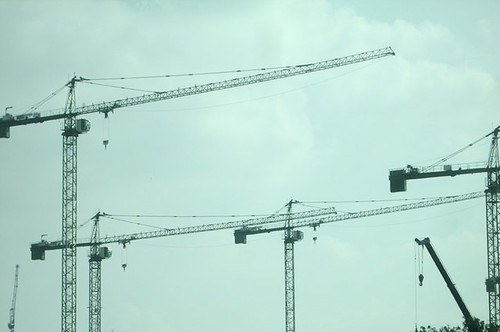
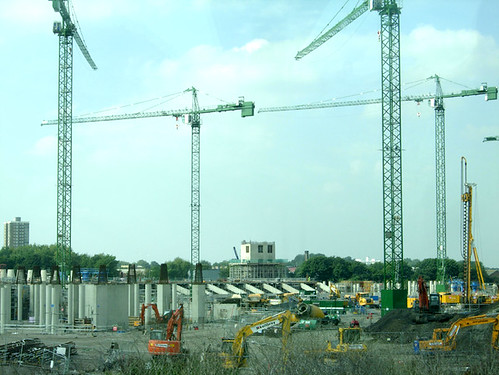
The skyline is cluttered and crowded with cranes.

Cranes on London 2012 Olympic site

Over 200km of electricity cables criss-cross the site at the moment. These will all be moved into two underground tunnels.

Pylons on London 2012 Olympic site


This is the beginning of the Olympic stadium. The piles in the bottom left are the first of 3,500 on which the stadium will stand. Its design is magnificent - it's changeable fabric curtain design gives it flexibility and democracy, enhancing its rather simple structure.


Beginning of Olympic stadium, London 2012 Olympics site


These hollows are for the foundations of Zaha Hadid's Aquatic Centre.

Site of Aquatic Centre, London 2012 Olympic site

This canal was built to transport material to and from the site. The Olympic stadium will be on an island site, surrounded by water.

Canal on London 2012 Olympic site


The island site, plus the iconic wave roof on the Aquatics Centre, and the ubiquitous Thames imagery used in so many London logo leads me to think that water should be a theme of these Olympics. The opening ceremony should emphasise water, movement, fluidity, change, from ancient to modern, from 1908 to 1948 to 2012.

On the tour, I discovered that a public walkway goes right through the park, so I will definitely be going back to keep up with the progress.

Films of the Olympics, 1900-1924

Saturday, September 27, 2008

I went to the BFI last night to watch The Olympic Games on film, 1900-1924, a fascinating set of vintage films.

The films revealed much about the Olympics - sometimes bad, such as the frankly racist Anthropological Days which tried to show that white people were a physically superior race.

The best stories came from the marathons, such as, in St Louis in 1904, the chap who came second travelled some of the race in a truck, the fairly widespread use of strychnine as a performance enhancer, and Dorando Pietri's misadventures from London's 1908 Olympics.

My highlight came from the 1924 Paris Olympics with the images of the control station - the runners came in, sweating, panting, exhausted, and the French served up glasses of red and white wine. Brilliant.

Olympic posters at the V&A museum

Monday, August 18, 2008

The V&A Museum of Childhood currently have an exhibition of A Century of Olympic Posters (until Sept 7).

For me, the posters that work best are those that use Olympic symbols, and mix them with sporting icons, and add visual elements of the host nation or city.

There was a definite trend - earlier posters were quite illustrative, realistic and detailed, with the lines becoming clearer and more minimal as time went on.


My three favourites were:


Mexico 1968 Olympic poster: Starting with Mexico 68, this adds more parallel lines to give the impression of race track lines and Mayan designs. Overall, an eye-catching and dynamic poster, and very in keeping with the symmetrical OpArt trends of the 60s.


Moscow 1980 Olympics poster: Another simple design but one which is really effective: the lines look like track lines and are a visual link to the Kremlin's architecture.


Montreal 1976 Olympic poster: again, this uses a simple design but really gives an impression of movement which is so part of the Olympics and sport.
London's 2012 logo was featured in the exhibition, and I have to say that, of recent efforts, I think it is the best (certainly beating Beijing and Athens), but doesn't seem to have any element of sport in it which is a shame.

A French poster also caught my eye . If you think the sporno trend of homoerotic sportsman is new - check out these boys from the 1924 Paris Olympics.

Olympics: Togo's first ever medal

Tuesday, August 12, 2008

I'm thoroughly enjoying the Olympics so far. While the Chinese, Australians, Koreans and Americans are winning medals all around them, I love to hear about the achievements of smaller countries.

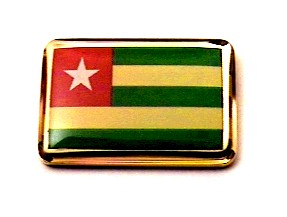
The two countries I follow - Ireland and Austria - have had some success. Austria has a silver (in judo) and a bronze (in swimming) - not bad for a landlocked country! Ireland came very close today with canoeist Eoin Rheinisch coming 4th in the men's kayaking. So close - but I'm cheered to hear he was beaten to the bronze by Benjamin Boukpeti who has won Togo its first ever Olympic medal. Full story here

So let's be upstanding for the Togolese national anthem - as national anthems are always entertaining.


London's 1908 Olympics walking tour

Friday, July 11, 2008

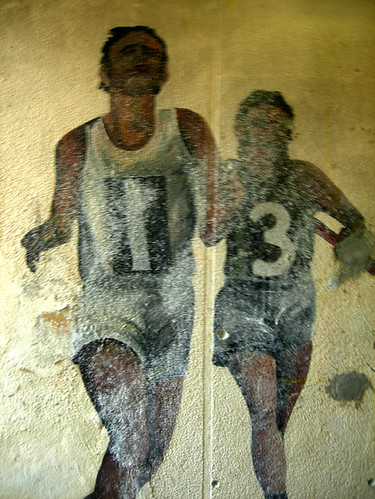
I've been on a walking tour around west London, taking in the sites and stories of London's 1908 Olympics. Held in a stadium at White City, which was demolished in the 80s (the BBC are on the site now), memories of the Olympics remain, such as this mural and this street.


Mural on 1908 Olympics in underpass

Dorando Close

The street is named after Italian Dorando Pietri who finished the marathon first, but didn't win. Starting at Windsor Castle, the marathon wound through north and west London. Princess Mary at Windsor Castle asked that it start at the east wing - 'so the children could watch'. Meanwhile, Queen Alexandra requested that the finish line be in front of White City's Royal Box.

Both actions added several hundred yards to the race.

By the end, Pietri (also a Soho ice-cream seller) was in first place. Entering the stadium, he ran the wrong way and collapsed. Two officials - being sporting British chaps - helped him to the finish line. And he was disqualified! But, next day, Queen Alexandria presented him with a special silver cup, and he's now immortalised.

See here & here for more Olympic tales. Or go on this tour - there's another in August.

Finishing line of the White City Stadium