
On Saturday last, I went for an electrical walk. Artist Christina Kubisch has developed headphones which detect electromagnetic fields and transmit them as sound signals. The wearer is free to go wherever they wish, wearing the headphones, although a map is helpfully provided. Kubisch says that "the “electrical walk” is not an event, rather it is a slow walk which might reveal what was unknown before."
I started from the Goethe-Institut where the headphones are collected. I walked towards Hyde Park, with an ever present hum in my ears. This hum rarely diminishes, and stays almost constant throughout the walk with the only changes being an intensification.
Outside the Austrian Trade Commission, the hum became very loud: hummmmmmmmmmmm
Outside residential homes, it became more insistent: hrurmrurmrurmrurmrurmrurmm
Passing cars zip by like wasps, with a high-pitched zzzzzing.
A bus was like a larger bee, with more another high-pitched but longer zzzzzzzzziiiiiiiiing.
The induction loop for hearing aids at Imperial College amplifies the sounds of the foyer, so everything sounds louder.
The lifts in The Science Museum have an LED screen to show the floors. When the screen changes, the headphone make a rattling noise: tsht-tsht-tsht-tsht
Television screens made a loud, incessant din: rnarrnarrnarrnarrnar
The hums became louder and lower in pitch near CCTV cameras: huuuuuuuhhhhhhmmmmmm
The security shields at the shop of the Natural History Museum make a harsh, staccatto sound: rat-a-tat-tat-tat-rat-a-tat-tat-rat-a-tat-tat-tat
I went to a tube station. Oyster card readers make a beep to our hears, but with the headphones this beep was harsher: zitzitzitzitzitzit
A tube train was a cacophony of noise.
I passed a traffic warden who made the headphones louder than any other person.
The whole walk was fascinating, for the very reasons Kubisch stated. The headphones reveal what is there but we cannot see, nor can we feel. The revelation of these electromagnetic fields is unsettling. The magnetics are ultimately not harmful, but what effects could they have on our bodies?
Hearing electromagnetics as sounds gives them with a physical sense. They become real, and are all around and invasive. The walker in a city is transformed from a free, strolling flaneur to an element within a greater forcefield, surrounded and followed by invisible boundaries.
More information on Christina Kubisch - Electrical Walks here.
Sound walk
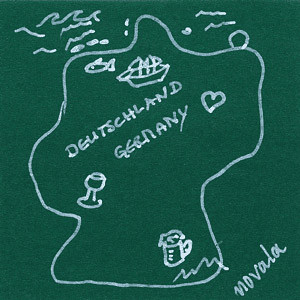
Wednesday, August 23, 2006Germany by Novala, Norway, Belgium by Alice
Thursday, August 10, 2006I've collected 3 further maps for my EuroGlobe project.
I asked Novala, a German woman living in Vienna, to draw Germany. She has a very interesting blog here.
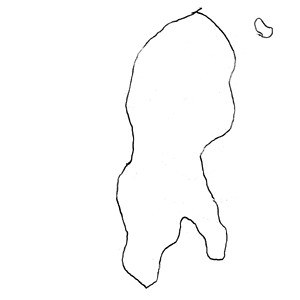
I sent two letters to two addresses in Oslo, with envelopes and paper. One recipient has returned a map of Norway. This drawing is by either Erik or Joakim - I don't know which! Hopefully whomever it is will email me so I can attribute them correctly.
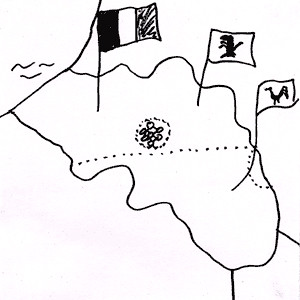
Finally, Belgium. Last weekend, I went to a Latin American carnival being held in South London with a vague notion of collecting country maps. I thought I'd maybe meet people from Colombia, Ecuador, Peru - all of which were strongly represented in the carnival. I eventually spoke to a man from Bolivia. I may have inadvertently annoyed him as he was from Santa Cruz, an area which has a growing autonomy movement. He didn't seem keen on drawing the map, but mentioned that the woman with him was from Belgium. So here, the result of a Latin American carnival is Belgium drawn by Alice
Lamb's Conduit Street
Monday, August 07, 2006
Lambs Conduit Street is a small, quiet street in London's Bloomsbury. I pass through it regularly as I work nearby. The businesses on the street are idiosyncratic as there are no chain stores. Each store is an independent retailer: there are grocers, bookshops, opticians, hairdressers, restaurants and bars.
One of the street's most prominent outlets is an undertaker and funeral parlour. The blinds are bright red, with a window display of old London maps showing that the street bounded onto a cemetery in earlier times.


Window displays are striking. These are in the windows of a naturopathy shop and a sweet shop.


There are also residential flats on the street. Period features have been carefully preserved. Lambs Conduit Street feels, a little oddly, like a modern street from the past.


Now, however, Starbucks are about to open an outlet on the street. This chain store potentially threatens the character of the street. The existing retailers have started a petition - it will be interesting to see how this develops.


S-H-O-R T-A-S-S
Thursday, July 27, 2006Earlier on the tube platform, I stood next to a very short guy. I'm not very tall, yet he only came up to my chest level.
I smiled, thinking how clever he was to both celebrate and make fun of his size. I tried to hide my smile (English reserve is catching). He noticed me, though, and laughed at my obvious admiration.
It was one of those special, simple, big city moments.
New Europe | Old Europe
Friday, July 21, 2006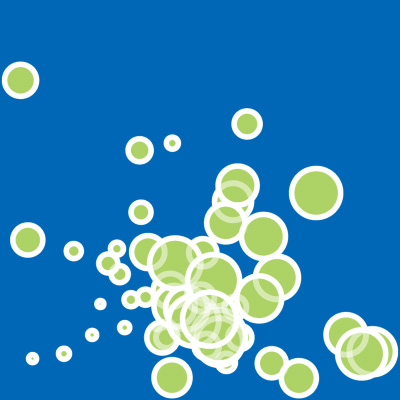
I was recently led to think about the theme "New Europe". This is understood to mean the proliferation of 'new' states in Central and Eastern Europe - what were once just one country have split and expanded into 2, or 6, or 16.
I composed this image based on that idea. Each circle corresponds to a European country. The circles increase in size, following the declared independence of countries. Thus, the smallest is the oldest, the largest is the newest.
San Marino is "Europe's oldest country" as it was founded in the 4th century. Serbia is Europe's newest, officially established in June of this year after Montenegro voted in a referendum to separate from Serbia. Each country is also laid down in order, thus Serbia is to the front, in the lower centre of the picture.
And, below, is the opposite - the countries of Europe, with the oldest as the largest and the newest as the smallest.

Place Quote: Syria
Wednesday, July 19, 2006And here in Syria, the very place that had given the world this elegant script, half the people were still illiterate.
- Paul Theroux, The Pillars of Hercules, p.439
Place Quote: Benidorm
- Paul Theroux, The Pillars of Hercules, p.50
Place Quote: Benidorm
- Paul Theroux, The Pillars of Hercules, p.34-5
Place Quote: Mediterranean sea
- Paul Theroux, The Pillars of Hercules, p.27
My World: how people see and draw the world
Monday, July 10, 2006With just a pad and pen, I ask people to 'draw the world'... 'draw their world'... 'the world as they see it'... I'm purposefully vague. It's not a test od memory or skill, but an attempt to express imaginative geographies and more.
The images are the fascinating, funny, fearless results.
· Go to Flickr to see the My World project, where I ask people to 'draw the world'
EuroRevision: Europe squared.
Sunday, July 09, 2006I want to collect a map for every country in Europe. Get in touch if you want to help.
On conventional world maps, each country is shown with reference to their size.
EuroRevision changes this view by re-positioning each country's map on a 10cm x 10cm piece of paper.
Panic
Saturday, July 08, 2006Yesterday was, as most know, the anniversary of last year's bombings in London. That was in my first week living in London - an eventful start to my time here. Friends and relatives urged me to think about returning to Ireland but I resolutely held my ground. The next day I went to work on the tube. I wasn't worried.
Yesterday morning's breakfast TV news coverage of the bombings was widespread, going so far as to show mobile phone video footage from inside one of the carriages. I felt a little nervous, as I went to the tube. I chided myself for being over-anxious, and put on some jaunty Swedish schlager music to cheer myself. Nothing can be wrong in the world when Shirley Clamp's trilling Att Alska Deg.
Yesterday evening, my train was held in Victoria. The driver came over the PA to say there was a problem on the line. He didn't know why. I resumed listening to my music. I could see nervous eyes darting about the carriage. The anxiety was infectious. The driver again came over the PA, he said the line was down between Highbury and Walthamstow. He'd give us "the real reason" as soon as he had it.
Some people rushed off the train. I began to feel nervous, panicky. I realised I could get a bus home, so jumped off the train and out of the station. I saw people running. I wondered why. I saw a policeman talking into his radio. I wondered why. The bus-stop was completely crowded. I wondered why. People rushed across roads. I wondered why. The bus was crowded, so I decided to walk home. I stopped at another tube station along the way. It was closed. I wondered why.
When I got home, I learned that the line was delayed due to a person under a train. Nothing unusual there, but it struck me how I had let terror beat me, scare me. My nerves increased with every noise I heard on my way home. London, a city of opportunity and enjoyment, had become a city of fear.
Site
Friday, July 07, 2006 For the past year or so, I have asked friends and strangers to draw the world. I have, so far, collected 46 images.
In addition to this, I am starting an experimental project in which I ask European people to draw maps of their countries, compiling these together to make one large map of the world. I do not know if this will be successful, but the process of compiling should be interesting. This image would re-draw Europe, with each country given a similar space rather than their geographic, measured areas.
Hiroshima Peace Candles
Thursday, May 25, 2006The site where the atomic bomb was dropped on Hiroshima is now marked by a memorial park to peace. Just one building remains from the bombing with the story of the atomic bombing told by a museum in the park. The park swarms with tourists. We visited during the Hiroshima Flower Festival, which featured song and dance displays by school children of all ages.
Despite the energy and noise, the park is dedicated to peace. On paying a small sum, candles were available to the public to write messages of peace. People, young and old alike, write their messages.

 |  |  |
The candles are placed on tables, or stands or in pattern formations. The whole park fills with candles. Each evening, the candles are lit by volunteers.
 |  |
Once the candles are lit, and darkness falls, the park is illuminated by candles, all burning orange and yellow with messages of peace.
 |  |  |  |
 |  |  |  |
 |  |  |  |
 |  |  |  |
 | |||
And, then, each evening, around 10pm, as if to remind us of fragile nature of peace, the candles are extinguished.

City full of light
Tuesday, May 16, 2006Tokyo, by day or by night, is a city full of light: neon, plastic, bright and colourful. During a stay in Tokyo, Fukuoka and Hiroshima, the visual senses are charged with explosions of colour and light and plastic. Cartoon characters and manga abound in Japan, advertising even the most serious of businesses. Household appliances, toys and models all have faces - humanised into smiling creatures.
Plastic, tacky, amazing figurines and toys sell all over Japan. These items have no discernable use except to please the visual senses. Japan, as a nation, works hard and plays hard. Rows upon rows of consumer products abound. In the 'entertainment districts', the streets are filled with rainbows of neon, moving lights and noise. Pachinko and slot machines are riotous halls of flashing lights and loud music and sirens.
The effect is overwhelming and leaves you thinking that Japan has a two-sided design tradition - that of elegant, simple design and of excessive, camp, tacky, chaotic colours and lights.
The photos below were taken in the three cities I stayed in, but inspired by my first weekend in Tokyo in particular in Kabukicho (the red-light district) and Harajuku (the youth shopping district). Click on any photo to expand.
 |  |  |  |  |  |
 |  |  |  |  |  |
 |  |  |  |  |  |
 |  |  |  |  |  |
 |  |  |  |  |  |
 |  |  |  |  |  |
 |  |  |  |  |  |